
In response to the panic triggered by Trump's trade policies, the RBI net sold approximately $43 billion in the second half of FY25 to curb volatility, as the rupee plunged to a low of 87.95 per dollar in February this year.

The protesting farmers' main demand to legalise the minimum support price (MSP) regime has divided opinion. One school of thought says it would lead to crop diversification and help India keep under check its burgeoning import bill on edible oils and pulses, while another says it would incentivise farmers to produce low-quality crops. Contrary to popular perception, India has a trade surplus in agriculture and allied activities, which stood at $18.65 billion during 2022-23 (FY23) against $15.92 billion in the previous year. However, the surplus was mainly on account of rice, wheat, sugar, spices, and buffalo meat.

Alloting more funds for MNREGA and PM-KISAN could wipe out the entire additional money that the Centre may have for FY25.

Elevated food price-led inflation could become a sore point for markets, which they seem to be ignoring at current levels, observe analysts. Retail inflation in India - as measured by the Consumer Price Index (CPI) - came in at a three-month high of 6.52 per cent in January 2023, compared with 5.72 per cent in December and 5.88 per cent in November 2022. The inflation print for February, according to Madan Sabnavis, chief economist at Bank of Baroda, will be critical for the Reserve Bank of India's monetary policy committee.

The finance ministry on Thursday raised concerns over the possible impact of El Nio conditions on India this year, saying if recent forecasts came true, the country could see lower agricultural output and higher inflation. "Some meteorological agencies predict the return of El Nio conditions in India this year. "If these predictions are accurate, then monsoon rains could be deficient, leading to lower agricultural output and higher prices," the ministry said in its monthly economic review.

The finance ministry on Thursday sought to clarify that there was no distress in household savings and the data indicated that changing consumer preference for different financial products was the real reason for the change in the pattern of household savings. The clarification comes in the backdrop of Reserve Bank of India data showing that household net financial savings rate is at its lowest in decades, at 5.1 per cent of GDP in FY23 compared to 7.2 per cent of GDP in FY22. The divergence in the data for household gross financial assets and liabilities is not a cause for concern for the government, as the loans have largely been taken to buy real assets or automobiles, the finance ministry said.

'We will have to wait for one more year to cross the 7% mark, which should be possible in the absence of any disruptive reform,' points out CARE Ratings Chief Economist Madan Sabnavis.

Growth rate in per capita income is projected to fall to the lowest in 21 years this financial year - except for the financial years 2019-20 (FY20) and 2020-21 (FY21) - according to the first advance estimates. During the last 21 years, the two periods - FY20 and FY21 - saw growth rates in per capita income lower than 7.9 per cent, seen during FY24. This was despite the real gross domestic product (GDP) being projected to grow by 7.3 per cent in the current financial year by the first advance estimates.

A depreciating rupee, which briefly hit 80 to the dollar on Tuesday, may boost India's exports but price-inelastic imports of crude oil and gold would mean limited relief on the trade deficit, which clocked a record $26.2 billion in June. Due to global risk aversion on the back of geo-political tensions and aggressive policy tightening by the Fed, the dollar has appreciated against most currencies, including the rupee. And, with other currencies depreciating, India's comparative advantage in this respect may be limited.

The economy has shown sharp resilience in the past and has also bounced back in good time. We could hence expect a similar trajectory next year, observes Madan Sabnavis, chief economist, CARE Ratings.

'The expeditious enactment of labour codes and strategic measures to bridge the skills jobs gap are critical.'

Investment growth moderated slightly in the economy during the first quarter (Q1) of the current financial year (2023-24, or FY24), notwithstanding the front-loading of capital expenditure (capex) by the Centre. This was also the case despite a pick-up in demand during the period after two dismal consecutive quarters. Although growth in gross fixed capital formation (GFCF), representing investment, fell to a five-quarter low of 7.96 per cent, the comparison with the first two quarters of the previous year is a bit askew due to the low year-on-year (Y-o-Y) base of those periods.

Uncertainty looms over India's export outlook, with the new Covid-19 variant Omicron spreading rapidly across the country's key shipment destinations. With the US and parts of Europe witnessing more than 100,000 Covid-19 cases a day, exporters expect some disruption. However, there may not be an immediate decline in exports from India because the order books remain strong at least for the next few weeks, they said.

'We should look at is full year's growth rather than quarter numbers.'

In mid-March this year, the finance ministry asked state-run banks to review their gold loan portfolio for the two-year period between January 1, 2022, and January 31, 2024. This business had grown at a fast clip. Reserve Bank of India (RBI) data has it that it grew 15 per cent to Rs 1 trillion in FY24. Now, in recent times, any kind of exuberance in financial services has seen the authorities swoop down - be it pushing the lines on governance or unsecured credit.

The economy may grow by around 7 per cent this financial year as estimated by the Monetary Policy Committee (MPC) of the Reserve Bank of India (RBI), say economists with various organisations. The first advance estimates for 2023-24 will be released on Friday by the National Statistical Organisation (NSO), an exercise done for calculating ratios such as the fiscal deficit. The interim Budget will be presented on February 1.

The Union government could target a fiscal deficit of 5.8-6 per cent of nominal GDP for 2023-24, and it should continue its capital expenditure push and look to simplify the personal income tax regime, economists recommended Finance Minister Nirmala Sitharaman and her team during their pre-Budget interaction on Monday. Starting last week, Sitharaman had eight pre-Budget consultations this time. More than 110 invitees representing seven stakeholder groups participated in these meetings, the finance ministry said in a statement. The stakeholder groups included representatives and experts from agriculture and agro-processing industry; industry, infrastructure & climate change; financial sector and capital markets; services and trade; social sector; trade unions and labour organisations; and economists.

The sudden stop in economic activity led to a sharp decline in employment-intensive sectors like construction, manufacturing and trade, hotels, transport etc.

The wholesale price-based inflation eased for the eighth consecutive month to 4.73 per cent in January on easing prices of manufactured items, fuel and power. The wholesale price-index (WPI) based inflation rate was 4.95 per cent in December 2022 and 13.68 per cent in January 2022. Inflation in food articles, however, rose to 2.38 per cent in January, from (-) 1.25 per cent in December, 2022.

But the government will present a second tranche of Supplementary Demands for Grants during the Budget session of Parliament in February, when it can seek additional spending.

There has been a sharp recovery in the headline corporate earnings in the April-June 2023 quarter (Q1FY24), after a dismal showing by early bird companies. The combined net profit of the 983 listed companies that have declared their quarterly results, so far, was up 64.7 per cent year-on-year to record a high of Rs 2.68 trillion in the first quarter, but growth in earnings remained lopsided because most of the incremental gains came from a handful of companies. Moreover, the quarterly numbers showed a continued slowdown in revenue growth.

The Reserve Bank of India (RBI) will maintain the policy repo rate at 6.5 per cent during its upcoming June 8 announcement, considering the easing of retail inflation in April and the potential for further decline, indicating the effectiveness of previous policy rate actions, anticipate experts. Headed by Reserve Bank Governor Shaktikanta Das, a meeting of the six-member Monetary Policy Committee (MPC) is scheduled for June 6-8. The decision of the 43rd meeting of the MPC would be announced on Thursday, June 8.

The Centre is staring at a combined shortfall of up to Rs 1 trillion in excise and Customs revenues in the current financial year (FY23) compared to the Budget estimates (BE), mainly because of duty cuts on edible oil and petroleum products. The government set a target of Rs 3.35 trillion for excise and Rs 2.13 trillion for Customs mop-up for FY23 while presenting the Budget in February. "As excise duty collection is mainly driven by diesel volumes, we might see a clear gap in the level budgeted for FY23, following the reduction in cesses on petrol and diesel in May. We are expecting somewhere between Rs 80,000 crore and Rs 1 trillion dip in excise and customs duty collections," a senior government official told Business Standard.

JP Morgan's decision last week to include Indian government bonds in its Government Bond Index-Emerging Markets (GBI-EM) index and the index suite from June 2024 may be a sort of blessing for India, as the move is estimated to result in an inflow of $25 billion of foreign portfolio investments into the country. The development comes at a time when the spread between the benchmark 10-year government of India bond and the 10-year US government bond has declined to its lowest level in more than 17 years. Low yield spreads make Indian bonds less attractive to foreign portfolio investors (FPIs).

According to Ajai Sahai, director-general and CEO of Federation of Indian Export Organisations, rising cases are a cause for concern as it adds to the uncertainty and may impact exports.

The GDP has been estimated at Rs 126.54 lakh-crore (Rs 126.54 trillion).

However, the growth, driven largely by a bumper rabi harvest and facilitated by relaxation in lockdown, may not have resulted in a big rise in income for a section of farmers.

As a percentage contributor to nominal GDP, PFCE's share was 60.1 per cent in FY23, compared with 59.6 per cent and 60.8 per cent in the two preceding fiscal years. "Although PFCE is expected to grow 7.7 per cent in FY23, we believe it is still short of a broad-based recovery. "The current consumption demand is highly skewed in favour of goods and services consumed largely by the households falling in the upper income bracket. "A broad-based consumption recovery, therefore, is still some distance away," said Sunil Kumar Sinha, principal economist with India Ratings.

October infrastructure output, which contributes nearly 38 per cent to the industrial output index, was up 3.2 per cent annually.
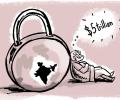
The wait for India to become a $5-trillion economic powerhouse by 2024-25 (FY25) is going to take longer than what the finance ministry had originally intended, according to the International Monetary Fund (IMF). The vision will instead be achieved in 2028-29 (FY29), reveals the IMF data, illustrating a four-year delay. Chief Economic Advisor (CEA) V Anantha Nageswaran had in February said India would become a $5-trillion economy by 2025-26 or the following year, on the back of 8-9 per cent sustained growth rate in real gross domestic product (GDP). However, the IMF data conveys that the economy will be $4.92 trillion in FY28, clearly alluding to the fact that the target will be realised in FY29.

The Reserve Bank is likely to maintain status-quo on the key interest rates for the third time in a row in its upcoming bi-monthly policy review despite the US Federal Reserve and the European Central Bank hiking benchmark rates, as domestic inflation is within the RBI's comfort zone, say experts. The borrowing cost which started rising in May last year has stabilised with RBI keeping the repo rate unchanged at 6.5 per cent since February when it was raised from 6.25 per cent. In the previous two bi-monthly policy reviews in April and June the benchmark rate was retained.

India's inclusion in JP Morgan's bond index can channel billions of dollars into India. How will the government securities market handle it?

Stemming from the default of IL&FS in September, on various debt instruments including commercial papers, bonds and loans, the financial sector has been facing a liquidity crunch for the last eight to ten weeks.

This may come as a surprise to many. Retail price inflation in petrol was the lowest at 10.21 per cent in March since November 2020. In diesel, it scraped the bottom of the barrel at 5.19 per cent in the last month of 2021-22 since February 2020. Even liquefied petroleum gas (LPG) was at a nine-month low of 9.97 per cent in the month.

Their implementation is expected to create investment owing to improving ease of doing business as well as initiating pro-worker measures.

Gross value added in agriculture and allied activities clocked a healthy growth rate of 4.5 per cent at constant prices in the second quarter of FY22, up from 3 per cent during the same period last fiscal year and 3.5 per cent in Q2 of 2019-20. In the first quarter of FY22, gross value added in the sector was also 4.5 per cent. Growth in current prices was also a healthy 7.9 per cent in July-September 2021-22, up from 7.3 per cent in the same quarter last fiscal year. It was slightly less than the 8.7 per cent of the second quarter of 2019-20.

Investors and companies should brace for higher commodity prices over the next few weeks in the backdrop of Russian troops attacking Ukraine on Thursday. Meanwhile, US President Joe Biden threatened new sanctions against Russia for an act of aggression against Ukraine. All this, analysts believe, can push prices of key commodities such as crude oil, ammonia, urea, potash, and phosphates higher.

Experts attribute the lower target to increased allocation under the credit guarantee scheme for small businesses. Out of the Rs 3.21 trillion worth loans sanctioned under the Pradhan Mantri Mudra Yojana (PMMY) in the last financial year, Rs 3.12 trillion were disbursed to entrepreneurs, according to official data.

To meet the revised estimates for 2019-20, the central government will have to garner Rs 5.03 trillion in total revenues in March, which has seen the worst phase of the coronavirus pandemic so far and the resultant lockdown.

Since January 2021, the inflation rate in health has stood in the range of 6.08-8.44 per cent.
